

Good marketing makes specialist expertise easier to understand and assess. For Bristol’s professional firms, that means connecting what you know with what prospective clients need to see: relevant experience, clear thinking and credible evidence that helps them decide whether you are the right fit.
Bristol’s architecture practices, specialist consultancies and technology businesses have valuable expertise to share. The marketing challenge is to make that expertise clear to the people who might commission, recommend, invest in or work with them.
That requires more than a polished website or a busy publishing schedule. Potential clients need to understand what a firm does, where its experience is relevant and what evidence supports its claims. The right evidence differs between sectors, but the commercial purpose is consistent: help the right audience make an informed decision and feel confident enough to start a conversation.
This article looks at what marketing for Bristol’s professional firms needs to communicate. Beauxhaus is based in Bristol and works remotely with clients in London and across the wider UK. The examples below draw on that experience, highlighting approaches relevant to specialist firms in Bristol.
Digital marketing for professional services: making expertise clear
A firm can have a strong reputation among existing clients and still struggle to explain its value to someone encountering it for the first time.
Technical expertise may be buried in project documents. Important ideas may be shared at conferences but never developed into accessible written content. A website may list services without explaining the problems they solve or the decisions behind the work.
For small businesses and specialist organisations without a dedicated in-house team, addressing these gaps can be difficult. Marketing management competes with client delivery, and the people best placed to explain the work often have the least time to write about it. Clear messaging helps turn their knowledge into something prospective clients can understand and assess.
The answer is not necessarily more activity. A clear strategy starts with the questions prospective buyers need answered:
What does this firm understand about our situation?
Has it tackled a relevant challenge?
How does its approach differ from other options?
What evidence gives us confidence in its judgement?
What would working together involve?
Digital marketing becomes more useful when websites, content and social channels answer those questions consistently.
Different sectors, different evidence
Architecture and engineering are professional services too. We discuss the built environment separately here because portfolios, project experience and delivery constraints give its marketing a distinct emphasis. Technology businesses introduce another set of questions, particularly when an application or market is still developing.
These categories overlap, but they provide a useful starting point.
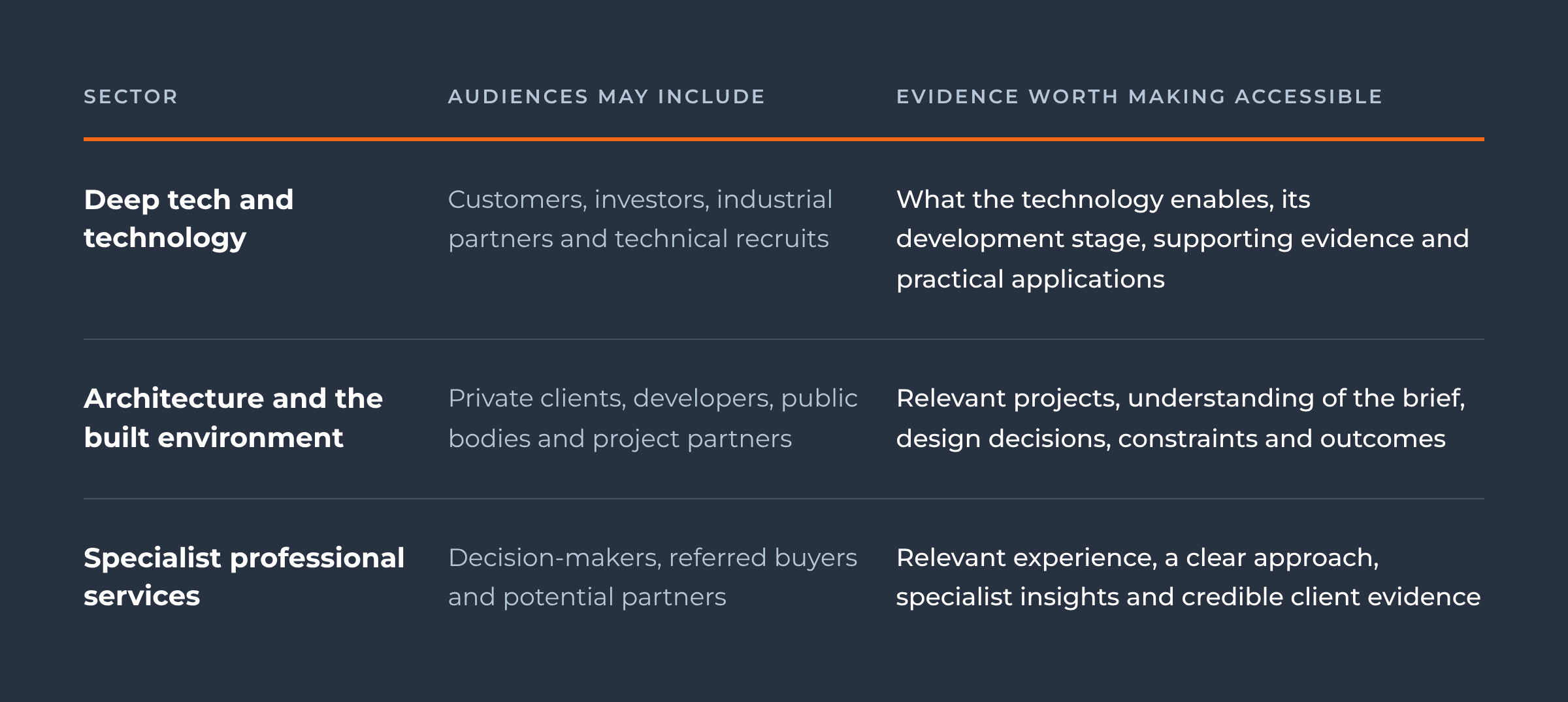
Different sectors need different evidence: connect what your firm knows and does with the questions its audiences need answered.
The distinction matters because generic claims about innovation, quality or excellence do little to explain suitability. A prospective client needs to recognise a connection between a firm’s expertise and their own challenge.
Making technical expertise commercially relevant
For technology businesses, communicating accurately is only part of the job. The audience also needs to understand why the work matters.
A technical description may explain how something functions without making its application clear. Conversely, simplifying too aggressively can remove the substance that gives a specialist audience confidence.
A useful marketing strategy connects the two: enough technical detail to be credible, organised around the questions a particular audience is trying to answer.
An industrial partner may want to understand how a technology could fit into an existing process. A prospective customer may need to assess feasibility, constraints and likely benefits. An investor may be considering the market opportunity alongside the development risk.
The same material will not answer every question equally well.
Explaining a practical application
Our co-founders worked with a global strategy and design consultancy whose expertise included digital tools for the built environment.
When the consultancy launched a free, open-source design configurator for precision-manufactured housing, our co-founders produced and edited a podcast episode in which members of the consultancy’s technology team discussed the tool. One of our co-founders then wrote an SEO article based on the episode.
The configurator combined spatial planning rules with precision manufacturers’ expertise to help users assess viable housing options for a development. The communication task was to explain what it enabled and how it could support early design decisions, rather than simply announce that an app existed.
For Bristol companies working with complex technology, content should explain the thinking behind an innovation and its relevance to a real task or decision. Our work as a deep tech marketing agency connects that technical substance with clear positioning, search visibility and thought leadership.
Helping architecture buyers look beyond the portfolio
A portfolio is important evidence, but finished photographs cannot explain every aspect of a practice’s work.
A prospective client may also want to understand the original brief, planning constraints, budget considerations, material choices or the way the practice worked with property professionals and other project partners. Describing a specific project can make that thinking visible, showing how the practice approached a real brief rather than relying on broad claims about its expertise.
This gives architecture practices useful material for websites, search and social media. A project can be presented through different questions without every channel repeating the same caption.
Our article on what clients see before they shortlist an architect explores that research stage in more detail.
From Google to Instagram to an enquiry
For a small residential architecture practice in Scotland, our work combined SEO with social media support. Initially, the practice wanted to focus solely on Facebook. We recommended adding Instagram because it required relatively little additional effort and offered another way to present their completed projects.
They later emailed us about a prospective client who had found the practice on Google, viewed its Instagram feed and then made contact. They were pleased to see the initiative working.
What the example demonstrates is the journey the prospective client described: discovery through search, followed by further research through social media, before contacting the practice.
The lesson is not that every practice needs every platform. It is that channels should be selected and maintained with the buyer’s research process in mind. Our approach to digital marketing for architects connects relevant visibility with clear project evidence and routes to enquiry.
Professional services marketing beyond referrals
For consultancies, executive-search firms, coaches and other specialist service providers, relationships can be central to business development. But an introduction does not remove the need to explain the offer.
A referred buyer may still visit the website, review an individual’s profile or look for published insights before deciding to make contact.
Professional services firms therefore need more than a list of capabilities. Their marketing should explain who their services are for, which challenges they address and how their approach works.
Named expertise, relevant testimonials and specific examples help make an intangible service easier to assess.
Replacing a generic presentation with specialist positioning
One counselling practice came to us after a previously reliable source of enquiries had declined. Their existing website did little to distinguish their expertise or help potential clients find them through search.
We built a new website around clearer positioning, specialist knowledge and SEO, supported by targeted content and a modest paid social campaign. One article became a leading source of website traffic, and the practice now receives a steady stream of enquiries. The site has also gained visibility in AI-generated search results.
The outcome belongs to the combined programme rather than a single article or channel. The website, content and advertising gave prospective clients several ways to discover and assess the practice.
For Bristol’s professional firms, the wider principle is relevant: communicate the substance of the service, rather than expect broad credentials or an established referral source to do all the work. Our professional services digital marketing support connects clearer positioning with websites, SEO and content.
Connecting content marketing with commercial goals
Content marketing is most useful when it makes expertise accessible beyond the room in which it was first shared.
A conference presentation can introduce an idea to an industry audience. An article can develop the reasoning, answer related questions and provide something people can find afterwards. A podcast can give specialists space to explain the decisions and experience behind their work.
The purpose is not to turn every idea into every format. It is to choose formats that serve the audience and connect them around a clear account of the firm’s expertise.
Extending recognition beyond existing connections
Our co-founders worked with the communications director of a global strategy and design consultancy to bring its specialist thinking to a wider audience. The consultancy’s visibility had relied largely on conferences and existing connections, with limited substantial content explaining the value of its work.
Our co-founders helped develop the podcast with the communications director and launched it for the consultancy, as well as producing and editing the show. Alongside this, they launched an SEO-led thought leadership programme exploring the consultancy’s core processes and thinking.
The articles achieved number-one rankings for key search terms, including one relating to its particular approach to design for manufacture and assembly, or DfMA.
The consultancy subsequently heard from a leading US steel manufacturer, who remarked that its SEO was clearly working because the firm had appeared wherever they looked. A director also observed that people now knew who they were when they attended conferences.
Digital content did not replace professional relationships. It extended the reach of the consultancy’s innovative thinking and helped it become familiar before those conversations took place.
Measuring marketing results against commercial goals
A marketing plan should distinguish between work completed and measurable results. Publishing an article is an activity. Attracting relevant visitors is a visibility result. Receiving a qualified enquiry is a business-development outcome. These are connected, but they are not interchangeable.
The measures should reflect the firm’s commercial goals, whether that means business growth, better-fit enquiries or greater recognition within a specialist market. Website data and enquiry records provide part of the picture; conversations with prospective clients help explain what influenced their decision.
Useful measures may include:
Visibility for searches related to priority services and sectors.
Visits to relevant service pages and project content.
Qualified enquiries and the suitability of the opportunities they represent.
Website conversion rates, interpreted alongside enquiry quality.
Feedback about how prospective clients discovered and assessed the firm.
Opportunities progressing towards proposals, commissions or other agreed next steps.
The architecture example shows why client feedback matters alongside analytics. The practice’s email revealed a journey across Google and Instagram that a single traffic report would not fully explain.
Where possible, ask new contacts how they found the firm and what they reviewed before enquiring. That information can help connect marketing decisions with the way buyers actually make choices.
A clearer marketing strategy for Bristol businesses
Bristol is the local context for this article, but not every Bristol firm needs a locally restricted strategy.
A residential practice may prioritise a defined service area. A specialist consultancy or technology business may need to reach buyers across the UK and internationally. Local connections and professional networks can remain valuable in both cases, while search and content extend the firm’s reach.
The starting point is to decide:
Which audiences and opportunities matter most.
What those audiences need to understand.
Which evidence the firm can make available.
Where that evidence should be published.
Who will take responsibility for delivery and review.
AI-assisted research adds another context in which that information may be encountered. Clear service explanations, accessible specialist thinking and credible evidence are worth developing for readers first, without treating AI visibility as a guaranteed outcome. Our AI search optimisation strategy article explores this further.
Working with a digital marketing agency in Bristol
If your firm has valuable expertise but limited time or resources to communicate it, Beauxhaus can help connect strategy with delivery. As a digital marketing agency in Bristol, we work remotely with specialist firms in London and across the wider UK. We bring together positioning, web design, SEO and content, with a clear scope and transparent communication about what we will deliver.
Book a free 15-minute introductory conversation.
Frequently asked questions
What should a Bristol marketing company understand about a professional firm?
It should understand the firm’s services, priority audiences, buying process and commercial goals before recommending activity. Branding, content and channel choices should follow that understanding. A useful working partnership also establishes responsibilities, access to specialist knowledge and how progress will be reviewed.
How can a professional firm build on referrals?
Make it easy for a referred buyer to assess the firm. Clear service pages, relevant project examples, specialist insights and credible client feedback can support the introduction and give existing contacts useful material to share.
Should Bristol businesses focus on local SEO?
That depends on where their intended clients are. Regional visibility can be important for firms serving a defined area, while specialist businesses working nationally or internationally need a search strategy that reflects those wider markets.
Does Beauxhaus only work with firms in Bristol?
No. Beauxhaus is based in Bristol and works with clients across the UK and internationally.